Humble Beginnings
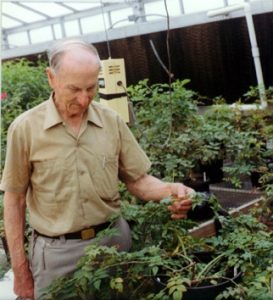
Work in the development of sustainable roses began in the early 1990s when Dr. Robert E. Basye established the Endowed Chair in Rose Genetics at Texas A&M University. His goal in rose breeding was to develop well-adapted, black spot resistant rose bushes “on which to hang those beautiful flowers”, leading to the release of Belinda’s Dream. In 2008 the Farm Bill established the Specialty Crop Research Initiative (SCRI) program under the USDA to accelerate the ongoing research in horticultural crops. This opened opportunities for funding research in ornamental crops where previously there was little or no funding.
Combating Rose Rosette Disease
In 2009, a group of researchers was established to develop molecular breeding tools for Rosaceae crops (RosBREED: Enabling Marker-Assisted Breeding in Rosaceae) and spawned proposals for projects such as “Tools for Developing Broadly Adapted Roses”. However it was not until 2010, when the American Rose Society Trust fund began funding rose breeding work at Texas A&M and RRD management at the University of Tennessee, that the preliminary research needed for developing a proposal for a large federal program took place.
After Star Roses and Plants and the Garden Rose Council organized an industry-wide Rose Rosette Disease conference, the first successful SCRI rose proposal was initiated. From 2014 to 2019, “Combating Rose Rosette Disease” focused on rose rosette research and accomplished the following goals:
- Development of diagnostics for RRV
- Accumulation of basic biology of both the virus and the vector mite (Phyllocoptes fructiphilus)
- Establishment of best management approaches to control RRD
- Evaluation of hundreds of roses for resistance to RRD
- Creation of genetic populations to identify the genomics of resistance
- Development of molecular tools to accelerate the breeding of RRD resistant roses
- Establishment of Roserosette.org to provide distribution maps and information for the identification and management of RRD
Results from, “Combatting Rose Rosette Disease”, as well as two other large SCRI projects, “RosBreed: Combining disease resistance with horticultural quality in new Rosaceous cultivars” (2014-2019) and “Tools for Genomics-Assisted Breeding for Polyploid Crops” (2020-present), were combined to create the SCRI “Developing Sustainable Roses” project with the long-term goal of developing sustainable rose landscapes based on cultivars resistant to RRD and black spot. The resultant project team is a national network of researchers, extension specialists, and industry and rose community partners who built research infrastructure and information toolkits to develop and deploy sustainable RRD and black spot resistant rose cultivars and information.
Developing Sustainable Roses
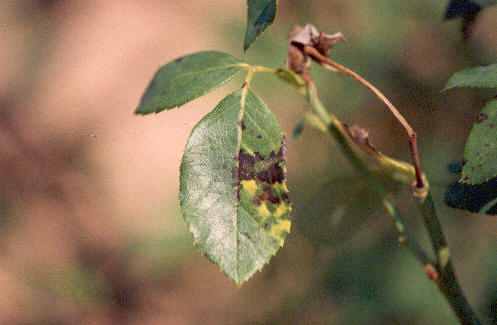
In October 2022, the USDA Specialty Crop Research Initiative granted funding to continue the research on rose rosette disease (RRD) and included rose black spot disease (RBSD, pictured right). The increased demand for carefree and sustainable roses sets the long-term goal of developing cultivars resistant to RRD and RBSD. The goals of this project include:
- Characterization of the host plant interaction with RRV and vector mite (Phyllocoptes fructiphilus)
- Establishment of a breeding platform to enable the development of adapted and commercially acceptable RRD and black spot-resistant roses
- Assessment of the socioeconomic impact of RRD management approaches
- Development of comprehensive research demonstration and education programs for RRD management
By studying trait inheritance in roses, identification of the genes, or quantitative trait loci (QTL), that condition resistance to disease will create useful molecular markers in the breeding of RRD-resistant roses and employ DNA sequence data to accelerate breeding disease resistant roses.