Since the 1940s, rose rosette disease has been a significant concern for breeders and consumers alike. The first case described the symptom known as “Witches’ Broom” which increases the number of spines and distorts the leaves of roses. In recent years, the disease has spread to garden roses and has led to a reduction in the use of roses in landscaping. The disease complex has three important biological factors: the rose rosette virus (RRV), the eriophyid mite vector, and the rose itself. The current best management practices for controlling the disease focus on either excluding the virus or preventing its spread by managing the movement and population size of the mite vector. However, all landscape roses are believed to be susceptible to RRD. Combining the following strategies is highly recommended to control eriophyid mite populations and the transmission of RRD. There is no cure once a plant is infected.
Disease triangle
Cultural Control
When transplanting new roses, carefully inspect plants for signs and symptoms of eriophyid mite activity and RRD, and regularly inspect them throughout the growing season for symptoms of RRD. Any plant displaying symptoms of infection should be removed and disposed of immediately, including its roots.
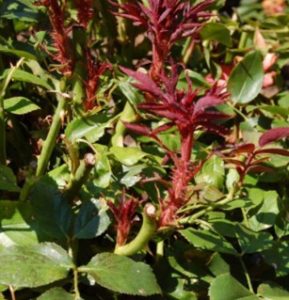
Abnormal discoloration and leaf distortion
Any plants with suspected infection should be quarantined from healthy plants and monitored for continued symptoms. Pruning can be used to remove the eriophyid mite, which tends to hide near buds and leaf scars. “Dead-heading” roses throughout the season may prove effective but will be more effective with the subsequent application of horticultural oils to control any remaining mites.It is extremely important to not only remove but dispose of infected plant material because it can possibly infect nearby healthy plants. So any roots, leaves, and other parts of infected plants should be cleared from an area before installing new, healthy plants. A leaf blower is not recommended for removing such debris, as it may blow mites onto healthy plants; instead, debris should be removed by hand, placed in a sealed bag, and disposed of off-site. It is also recommended that you wait 1 to 2 months after removing infected plants before transplanting healthy ones.
Mixed planting
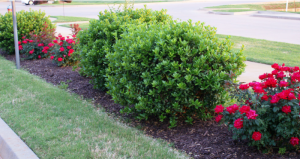
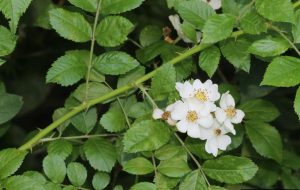
Any wild multiflora rose plants in the vicinity of rose gardens or nurseries should be removed. Cultivated roses should not be planted on hilltops or downwind of any known multiflora rose growth. Rose plants should also be well-spaced so that stems and leaves do not touch each other, which helps prevent eriophyid mite movement from plant to plant. Mixed plantings (roses with non-rose plants) are preferable to monocultures (all roses). Maintain health and vigor of rose plants by watering during periods of drought, testing soils, and applying fertilizer as needed, as well as controlling other diseases and insect pests.
Chemical Control
Miticides can be utilized to help control the eriophyid mite. However, those miticides known to control spider mites do not necessarily control eriophyid mites that transmit RRD, and mites may develop resistance to such chemicals. Some miticides that are registered for controlling both eriophyid and spider mites include:
Chemical control of rosesAvid®
Talstar® (bifentrhin)
Sevin® (carbaryl)
Thionex and Phaser (endosulfan)
Petroleum-based horticultural oils (avoid applying during high-temperature periods)
It is strongly recommended that you use these chemicals according to label instructions, and exercise caution when applying, to prevent poisoning and drift.
Biological Control
Adult spider mite and predatory mite
Predatory mites (Acari: Phytoseiidae) show promise for controlling eriophyid mite populations and developing RRD- and/or mite-resistant varieties of rose, but further studies are required. RRD has also spread east with the help of Rosa multiflora, a naturalized host and very susceptible introduced rose species, which has led to the infection of garden roses in home and commercial landscapes. The use of RRD as a biological control for R. multiflora has been proposed and studied, but the work has been opposed by the American Rose Society and rosarians in general.